
Table of Contents
Green Skills XII notes Pdf
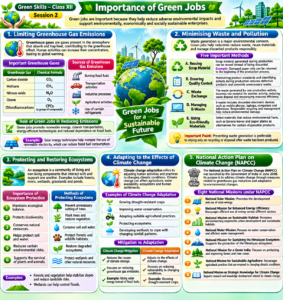
Session 2: Importance of Green Jobs
Green jobs are important because they help reduce adverse environmental impacts and support environmentally, economically and socially sustainable enterprises.
1. Limiting Greenhouse Gas Emissions
Greenhouse gases are gases present in the atmosphere that absorb and trap heat, contributing to the greenhouse effect.
Human activities can increase their concentration, leading to global warming.
Important Greenhouse Gases
| Greenhouse gas | Chemical formula |
|---|---|
| Carbon dioxide | CO₂ |
| Methane | CH₄ |
| Nitrous oxide | N₂O |
| Ozone | O₃ |
| Chlorofluorocarbons | CFCs (a group of compounds) |
Sources of Greenhouse Gas Emissions
Burning fossil fuels.
Transportation activities.
Industrial processes.
Agricultural activities.
Use of certain refrigerants.
Role of Green Jobs in Reducing Emissions
Green jobs promote renewable energy, cleaner transportation, energy-efficient technologies and reduced dependence on fossil fuels.
Example: Solar energy technicians help increase the use of renewable electricity, which can reduce fossil fuel consumption.
2. Minimising Waste and Pollution
Waste generation is a major environmental concern.
Green jobs help industries reduce waste, reuse materials and manage discarded products responsibly.
The textbook explains five important methods of minimising waste and pollution.
A. Reusing Scrap Material
Scrap material generated during production can be reused instead of being discarded.
Example: Damaged paper rolls can be returned to the beginning of the production process and used again as raw material.
B. Ensuring Quality Control
Quality control involves maintaining product standards and identifying defects during production.
Proper quality control reduces the number of defective products and prevents unnecessary waste.
C. Waste Exchange
Waste exchange is the process in which waste generated by one production activity becomes raw material for another activity.
This practice reduces waste disposal and encourages resource efficiency.
D. Managing E-Waste
Electronic waste, commonly called e-waste, includes discarded electronic devices such as mobile phones, laptops, computers and televisions.
Responsible recycling and management of e-waste help reduce environmental damage.
E. Using Eco-Friendly Materials
Eco-friendly materials are selected to reduce environmental harm.
The textbook mentions banana leaves and paper plates as examples of alternatives for certain disposable products.
Important point: Preventing waste generation is preferable to relying only on recycling or disposal after waste has been produced.
3. Protecting and Restoring Ecosystems
An ecosystem is a community of living and non-living components that interact with and support one another.
Examples include forests, rivers, wetlands, grasslands and ponds.
Human activities such as deforestation, pollution and excessive exploitation of natural resources can damage ecosystems.
Importance of Ecosystem Protection
Maintains ecological balance.
Protects biodiversity.
Conserves natural resources.
Helps protect soil and water.
Reduces certain environmental risks.
Supports the survival of plants and animals.
Methods of Protecting Ecosystems
Prevent unnecessary cutting of trees.
Plant trees and restore vegetation.
Conserve soil and water.
Protect forests and wildlife habitats.
Restore degraded ecosystems.
Protect wetlands and other natural resources.
Examples: Forests and vegetation help stabilise slopes and reduce landslide risks. Wetlands can help control floods.
4. Adapting to the Effects of Climate Change
Climate change adaptation refers to adjusting human activities and practices to changing climatic conditions.
Climate change can affect agriculture, water availability, ecosystems and human settlements.
Even when greenhouse gas emissions are reduced, adaptation remains necessary because some effects of climate change are already occurring.
Examples of Climate Change Adaptation
Growing drought-resistant crops.
Improving water conservation.
Adopting suitable agricultural practices.
Protecting ecosystems.
Developing methods to cope with changing rainfall patterns.
Difference Between Climate Change Mitigation and Adaptation
| Climate change mitigation | Climate change adaptation |
|---|---|
| Reduces the causes of climate change | Adjusts to the effects of climate change |
| Focuses on reducing greenhouse gas emissions | Focuses on reducing vulnerability to changing conditions |
| Example: Using solar energy instead of fossil fuels | Example: Growing drought-resistant crops |
5. National Action Plan on Climate Change (NAPCC)
The National Action Plan on Climate Change (NAPCC) was launched by the Government of India in June 2008.
Its purpose is to address climate change through measures related to greenhouse gas reduction and adaptation to environmental changes.
Eight National Missions under NAPCC
1. National Solar Mission: Promotes the development and use of solar energy.
2. National Mission for Enhanced Energy Efficiency: Encourages efficient use of energy across different sectors.
3. National Mission on Sustainable Habitat: Promotes environmentally responsible urban development and sustainable habitats.
4. National Water Mission: Focuses on water conservation and efficient water management.
5. National Mission for Sustaining the Himalayan Ecosystem: Supports the protection of the Himalayan ecosystem.
6. National Mission for a Green India: Focuses on protecting and improving forest and tree cover.
7. National Mission for Sustainable Agriculture: Encourages agricultural practices that can respond to changing climatic conditions.
8. National Mission on Strategic Knowledge for Climate Change: Supports research and knowledge development related to climate change.
Important Questions and Answers – Green Skills XII notes Pdf
Q1. What are Green Skills?
Answer: Green Skills are the knowledge, abilities, values and attitudes required to protect the environment, conserve natural resources and support sustainable development.
Q2. What are green jobs?
Answer: Green jobs are employment opportunities that help protect or restore the environment and support environmentally sustainable production and consumption.
Q3. Who is a green collar worker?
Answer: A green collar worker is a person employed in an environmental sector, such as a solar technician, organic farmer or recycling manager.
Q4. Mention five benefits of green jobs.
Answer: Green jobs improve energy and raw material efficiency, reduce greenhouse gas emissions, control waste and pollution, protect ecosystems and support climate change adaptation.
Q5. What is rooftop rainwater harvesting?
Answer: Rooftop rainwater harvesting is the process of collecting rainwater from rooftops and storing it for future use. It may also help recharge groundwater.
Q6. What is eco-tourism?
Answer: Eco-tourism is responsible tourism that promotes environmental conservation, reduces waste and encourages respect for natural surroundings.
Q7. What is waste exchange?
Answer: Waste exchange is a process in which waste generated by one production activity is used as raw material for another activity.
Q8. What is the importance of green jobs in reducing greenhouse gas emissions?
Answer: Green jobs encourage renewable energy, energy-efficient technologies and cleaner transportation. These activities help reduce dependence on fossil fuels and limit greenhouse gas emissions.
Q9. What is appropriate technology?
Answer: Appropriate technology is small-scale, environment-friendly technology suited to local needs and available resources.
Q10. What is the full form of NAPCC?
Answer: NAPCC stands for National Action Plan on Climate Change.
Q11. When was NAPCC launched?
Answer: NAPCC was launched in June 2008 by the Government of India.
Q12. Name any two green jobs in renewable energy.
Answer: Solar photovoltaic installer and wind energy technician.
Q13. What is climate change adaptation?
Answer: Climate change adaptation refers to adjusting human activities and practices to changing climatic conditions.
Q14. How does quality control help reduce waste?
Answer: Quality control helps identify and prevent defects during production, reducing rejected products and unnecessary material wastage.
Q15. Explain the role of green jobs in ecosystem protection.
Answer: Green jobs support forest conservation, soil restoration, water conservation, wildlife protection and restoration of damaged ecosystems. These activities help maintain ecological balance and biodiversity.
Quick Revision – Green Skills Class XII
| Important term | Key point |
|---|---|
| Green Skills | Skills supporting environmental protection |
| Green Jobs | Employment that protects or restores the environment |
| Green Collar Worker | Person working in an environmental sector |
| Organic Farming | Environment-friendly agricultural practices |
| Rooftop Rainwater Harvesting | Collection and storage of rainwater |
| Solar Energy | Renewable energy obtained from sunlight |
| Eco-Tourism | Responsible tourism supporting conservation |
| Green Building | Resource-efficient building design and operation |
| Waste Exchange | Waste from one process used in another |
| E-Waste | Discarded electronic equipment |
| Climate Change Adaptation | Adjusting to changing climatic conditions |
| NAPCC | National Action Plan on Climate Change |
| NAPCC Launch | June 2008 |
| National Missions | Eight missions under NAPCC |