
Table of Contents
Green Skills Notes Class XII | CBSE Class 12 CBSE Employability Skills
Class: XII
Subject: Employability Skills
Unit: 5 – Green Skills
Based on: NCERT Employability Skills Class XII
Sessions: 1. Green Jobs | 2. Importance of Green Jobs
Green Skills Notes Class XII | CBSE Class 12 NCERT
Introduction to Green Skills
Green Skills refer to the knowledge, abilities, values and attitudes required to protect the environment, conserve natural resources and promote environmentally sustainable development.
Today, the world faces several environmental challenges, including climate change, global warming, deforestation, air pollution, water pollution and depletion of natural resources.
Human activities such as excessive use of fossil fuels, cutting down forests and improper waste disposal contribute to environmental deterioration.
Green skills encourage individuals, organisations and industries to adopt environment-friendly practices that minimise environmental damage.
Examples of Green Practices
Planting trees and protecting forests.
Using bicycles and electric vehicles instead of conventional fuel-powered vehicles where practical.
Switching off taps when water is not required.
Reusing leftover water for watering plants.
Using cloth bags instead of plastic bags.
Reducing paper consumption.
Using biodegradable and non-toxic cleaning products.
Choosing energy-efficient appliances.
Conserving electricity and other natural resources.
Promoting recycling and responsible waste management.
Importance of Green Skills: Green skills help individuals adopt sustainable practices, reduce environmental pollution, conserve natural resources and support employment opportunities in environmentally responsible sectors.
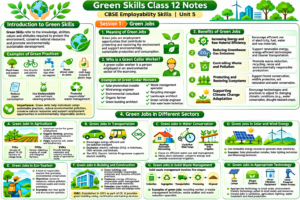
Session 1: Green Jobs
1. Meaning of Green Jobs
Green jobs are employment opportunities that contribute to protecting and restoring the environment and support environmentally sustainable production and consumption.
Green jobs exist in traditional sectors such as agriculture, construction and manufacturing, as well as emerging sectors such as renewable energy and environmental services.
According to the United Nations Environment Programme (UNEP), green jobs include employment in agriculture, administration, research and development, manufacturing and service activities that contributes substantially to preserving or restoring environmental quality.
Characteristics of Green Jobs
They promote efficient utilisation of natural resources.
They help reduce pollution and waste.
They support renewable energy and energy conservation.
They contribute to environmental protection.
They encourage sustainable production and consumption.
They help reduce greenhouse gas emissions.
They support climate change adaptation.
Examples: Solar panel installer, organic farmer, environmental consultant, wind energy technician, recycling manager and green building architect.
2. Who is a Green Collar Worker?
A green collar worker is a person employed in an environmental sector of the economy.
Green collar workers contribute to environmental protection, resource conservation and sustainable development.
Examples of Green Collar Workers
Solar photovoltaic installer
Wind energy engineer
Environmental consultant
Organic farmer
Green building architect
Waste management specialist
Recycling manager
Landscape architect
Green vehicle engineer
Solar water heater technician
Green collar workers may be employed in agriculture, renewable energy, construction, transportation, waste management and environmental services.
3. Benefits of Green Jobs
Green jobs play an important role in protecting the environment and promoting sustainable economic activities.
A. Increasing Energy and Raw Material Efficiency
Green jobs encourage industries and individuals to use electricity, fuel, water and raw materials efficiently.
Efficient resource utilisation reduces unnecessary consumption and helps conserve natural resources.
B. Reducing Greenhouse Gas Emissions
Green jobs support renewable energy, energy-efficient technologies and cleaner transportation systems.
These activities help reduce greenhouse gas emissions and dependence on fossil fuels.
C. Controlling Waste and Pollution
Green jobs promote waste reduction, recycling, reuse of materials and environmentally responsible production processes.
These practices help reduce air, water and land pollution.
D. Protecting and Restoring Ecosystems
Green jobs support forest conservation, wildlife protection, soil restoration and water conservation.
These activities help maintain ecological balance and biodiversity.
E. Supporting Climate Change Adaptation
Green jobs encourage the development of technologies and practices that help communities adjust to changing climatic conditions.
Examples include water conservation, sustainable agriculture and drought-resistant crop cultivation.
4. Green Jobs in Different Sectors
A. Green Jobs in Agriculture
Agriculture is an important sector for green employment.
Environment-friendly agricultural practices help conserve soil, water and biodiversity.
Organic farming is a method of growing crops using environmentally responsible practices while avoiding synthetic pesticides.
It helps reduce chemical contamination of soil and water and protects beneficial organisms.
Important areas of green employment in agriculture include organic farming, integrated pest management, farm mechanisation and agricultural tourism.
Farmer Interest Groups (FIGs): These are groups of approximately 15–20 farmers organised at the village level.
Farmer Producer Organisations (FPOs): These are farmer collectives, mainly involving small and marginal farmers, that help strengthen agricultural activities and livelihoods.
Krishi Vigyan Kendras (KVKs): These centres provide training, awareness and technological support to farmers, including methods for collecting, storing and reusing agricultural waste.
B. Green Jobs in Transportation
Transportation is a major area where environmentally responsible technologies can help reduce pollution.
Green transportation encourages the use of energy-efficient vehicles and alternative fuels.
Examples include electric vehicles, e-rickshaws, Compressed Natural Gas (CNG) vehicles and biofuels.
The textbook also discusses the Electric Vehicle Programme of Energy Efficiency Services Limited (EESL), which aims to encourage electric mobility.
Green job opportunities in transportation include electric vehicle technicians, e-rickshaw maintenance workers, green vehicle engineers and professionals working with alternative-fuel technologies.
C. Green Jobs in Water Conservation
Water conservation is essential for agriculture, households and industries.
Green jobs in this sector focus on efficient water utilisation, rainwater harvesting, water management and water quality testing.
1. Rooftop Rainwater Harvesting
Rooftop rainwater harvesting is the process of collecting rainwater from rooftops and storing it in tanks for future use.
It can also help increase groundwater levels through suitable recharge systems.
2. Cycle-Run Water Pumps
Cycle-run water pumps operate using human power instead of electricity.
They help conserve electrical energy while providing a way for people to exercise.
3. Bamboo Drip Irrigation
Bamboo drip irrigation uses bamboo channels to transport water efficiently to agricultural land.
It is an environment-friendly and economical method of irrigation. The bamboo can eventually decompose and contribute organic matter to the soil.
Examples of green jobs: Water conservation technician, water quality testing worker and water management professional.
D. Green Jobs in Solar and Wind Energy
Solar and wind energy are renewable energy sources that support cleaner electricity generation.
They help reduce dependence on fossil fuels.
Solar Photovoltaic Installer: A professional who installs and maintains solar panels on buildings or land.
Solar Lighting Technician: A worker who assembles, tests and repairs solar-powered lighting systems, including home lighting systems and streetlights.
Wind Energy Technician: A professional involved in installing, operating or maintaining wind energy equipment.
Other employment opportunities include rooftop solar workers and renewable energy field technicians.
E. Green Jobs in Eco-Tourism
Eco-tourism is a form of responsible tourism that encourages environmental conservation, reduces waste and promotes respect for natural surroundings.
Eco-tourism helps visitors understand the importance of protecting natural resources and maintaining environmental quality.
Its objectives include conserving resources, reducing pollution, minimising waste and creating environmental awareness.
Examples of green jobs: Eco-tour guide and eco-tourism operator.
F. Green Jobs in Building and Construction
Green buildings are designed, constructed and operated using environmentally responsible materials and resource-efficient practices.
Green building practices aim to reduce environmental damage during construction and building operation.
Important features include energy-efficient technologies, responsible water management, sustainable building materials and environmentally friendly construction processes.
Examples of green jobs: Green building architect, construction worker, landscape worker, water management technician and green building maintenance professional.
Indian Green Building Council (IGBC): The IGBC was established in 2001 as part of the Confederation of Indian Industry (CII). It provides green building rating programmes, certification services and training programmes.
G. Green Jobs in Solid Waste Management
Solid waste refers to discarded solid materials generated by households, industries, commercial establishments, institutions, agriculture and other activities.
Solid waste management involves the collection, segregation, transportation, processing and safe disposal of waste.
Its five main stages are:
Collection of waste
Segregation of waste
Transportation of waste
Processing of waste
Disposal of waste
Examples of green jobs: Recycling worker, e-waste management technician, waste auditor, waste reduction specialist and solid waste management worker.
H. Green Jobs in Appropriate Technology
Appropriate technology refers to small-scale, environment-friendly technology suited to local needs and available resources.
It aims to accomplish tasks efficiently while minimising environmental damage.
Examples include hand-powered water pumps, solar lamps, biogas systems, water filtration equipment and rainwater harvesting systems.
Green employment opportunities exist in biogas production, sanitation, water treatment, agriculture, lighting and food production.
Green Skills Notes Class XII | CBSE Class 12 NCERT Green Skills Notes Class XII | CBSE Class 12 NCERT
Physical Activity Trainer(Click Here)