
Entrepreneurial Skills MCQ Class 12 with Answers – Part 2 Entrepreneurial Skills MCQ with Answers
CBSE Class XII | Employability Skills | Unit 4 | NCERT Based
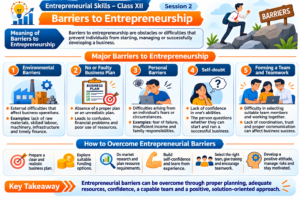
Table of Contents
Let’s Start with 20 More Entrepreneurial Skills MCQ Class 12 with Answers
Here are 20 additional Entrepreneurial Skills Class 12 MCQs (Questions 21–40) with answers and explanations.
These questions are different from the previous 20 and maintain a moderate to challenging difficulty level, focusing on conceptual understanding, practical situations, problem-solving and decision-making.
The questions cover all four sessions: Entrepreneurship and Entrepreneur, Barriers to Entrepreneurship, Entrepreneurial Attitudes and Entrepreneurial Competencies.
Session 1 – Entrepreneurship and Entrepreneur MCQ
21. An entrepreneur conducts a demand survey before launching a new product. What is the primary purpose of this activity?
A. To eliminate the need for financial investment
B. To guarantee that competitors will not enter the market
C. To assess customer needs and the market potential of the product
D. To avoid preparing a business plan
Answer: C. To assess customer needs and the market potential of the product
Explanation: A demand survey helps entrepreneurs identify customer requirements and assess whether a proposed product or service has sufficient market potential.
22. An entrepreneur develops a detailed report containing expected production costs, raw material requirements, market demand and possible business difficulties. Which entrepreneurial function is being performed?
A. Feasibility study
B. Wage employment
C. Routine supervision
D. Personal motivation
Answer: A. Feasibility study
Explanation: A feasibility study examines whether a proposed business idea is practical. It includes evaluating market demand, resource requirements, costs and possible problems.
23. An entrepreneur establishes a manufacturing unit, develops it into a self-sustaining enterprise, sells it and starts another business. Which type of entrepreneur does this describe?
A. Agricultural entrepreneur
B. Non-technical entrepreneur
C. Family business entrepreneur
D. Professional entrepreneur
Answer: D. Professional entrepreneur
Explanation: A professional entrepreneur develops a business until it becomes self-sustaining, then may sell it and establish another enterprise.
24. An entrepreneur develops innovative machinery to improve the efficiency of industrial production. Which type of entrepreneur is most clearly represented?
A. Business entrepreneur
B. Technical entrepreneur
C. Service entrepreneur
D. Social entrepreneur
Answer: B. Technical entrepreneur
Explanation: Technical entrepreneurs use their technical knowledge and expertise to develop innovative machines, tools, methods and industrial processes.
25. An entrepreneur regularly sets challenging performance standards and introduces innovative methods to achieve them. Which entrepreneurial motivation is most clearly demonstrated?
A. Avoidance of uncertainty
B. Dependence on competitors
C. Standard of excellence
D. Preference for wage employment
Answer: C. Standard of excellence
Explanation: The standard of excellence motivates entrepreneurs to establish high performance standards and achieve them through hard work and innovation.
Session 2 – Barriers to Entrepreneurship MCQ
26. An entrepreneur wants to expand a business but discovers that the required machinery is unavailable locally. Which combination would be most effective in addressing this difficulty?
A. Market research, alternative suppliers and mentor guidance
B. Ignoring equipment requirements and increasing production
C. Reducing employee communication
D. Abandoning the business without evaluating alternatives
Answer: A. Market research, alternative suppliers and mentor guidance
Explanation: Research, market surveys and guidance from experienced mentors can help entrepreneurs overcome environmental barriers, including machinery shortages.
27. A new entrepreneur has a clear business idea but does not know how to arrange resources, identify responsibilities or organise business activities. What is the most suitable solution?
A. Increase product prices immediately
B. Recruit employees without defining their duties
C. Depend entirely on competitors’ decisions
D. Prepare a systematic business action plan
Answer: D. Prepare a systematic business action plan
Explanation: A business plan provides direction by identifying objectives, resources, responsibilities and activities required to establish and manage an enterprise.
28. An entrepreneur has adequate financial resources and a suitable business plan but is unable to recruit employees who can work together effectively. Which barrier is most directly affecting the business?
A. Lack of capital
B. Forming a team and teamwork
C. Lack of entrepreneurial opportunities
D. Absence of market demand
Answer: B. Forming a team and teamwork
Explanation: Finding suitable workers and developing cooperation among team members are important entrepreneurial challenges.
29. An entrepreneur feels discouraged after receiving negative customer feedback and begins questioning their ability to run the business. Which action best reflects the textbook’s approach to overcoming this difficulty?
A. Stop communicating with customers
B. Ignore long-term business objectives
C. Focus on goals and seek encouragement from supportive people
D. Abandon the enterprise immediately
Answer: C. Focus on goals and seek encouragement from supportive people
Explanation: The textbook recommends focusing on long-term goals and seeking support from family and friends to overcome self-doubt.
30. An entrepreneur identifies strong demand for a new product but cannot arrange the necessary funds at the required time. Which barrier is being faced?
A. Environmental barrier
B. Interpersonal barrier
C. Lack of perseverance
D. Poor decision-making attitude
Answer: A. Environmental barrier
Explanation: The unavailability of monetary resources at the required time is an environmental barrier identified in the NCERT chapter.
Session 3 – Entrepreneurial Attitudes MCQ
31. A business owner identifies two possible expansion opportunities. After evaluating the expected returns and available resources, the owner quickly selects the more suitable option. Which entrepreneurial attitude is demonstrated?
A. Perseverance
B. Interpersonal skills
C. Organisational skills
D. Decisiveness
Answer: D. Decisiveness
Explanation: Decisiveness refers to the ability to make timely and profitable decisions after considering available opportunities.
32. An entrepreneur notices that a community lacks affordable after-school activities. Without waiting for competitors, the entrepreneur starts planning a new service. Which attitude is demonstrated?
A. Organisational efficiency
B. Taking initiative
C. Perseverance
D. Self-doubt
Answer: B. Taking initiative
Explanation: Initiative is the ability to take charge and act in a situation before others.
33. An entrepreneur manages a team consisting of employees from different educational and professional backgrounds. The entrepreneur encourages cooperation and resolves disagreements through discussion. Which attitude is most evident?
A. Financial risk-taking
B. Opportunity identification
C. Interpersonal skills
D. Long-term investment
Answer: C. Interpersonal skills
Explanation: Interpersonal skills help entrepreneurs work effectively with others, maintain positive relationships and encourage cooperation.
34. A business owner experiences repeated difficulties while introducing a new service but continues working towards the objective. Which attitude is most directly demonstrated?
A. Perseverance
B. Indecisiveness
C. Risk avoidance
D. Self-doubt
Answer: A. Perseverance
Explanation: Perseverance means continuing an activity even when it becomes difficult. It helps entrepreneurs remain committed to their goals.
35. An entrepreneur completes several business activities by carefully allocating time, energy and available resources. Which entrepreneurial attitude is demonstrated?
A. Personal motivation
B. Willingness to take risks
C. Self-confidence
D. Organisational skills
Answer: D. Organisational skills
Explanation: Organisational skills involve making optimum use of time, energy and resources to achieve desired objectives.
Session 4 – Entrepreneurial Competencies MCQ
36. An entrepreneur examines personal interests, strengths and the problems they would like to solve before selecting a business opportunity. Which competency is being developed?
A. Stress management
B. Knowing yourself
C. Managing quality
D. Financial control
Answer: B. Knowing yourself
Explanation: Knowing yourself is a competency associated with decisiveness. It involves identifying personal strengths, interests and the problems one wants to solve.
37. An entrepreneur studies a business idea and discovers that several competitors already offer similar services. The entrepreneur modifies the idea to provide something different. Which competency is most clearly demonstrated?
A. Avoiding responsibility
B. Dependence on competitors
C. Problem-solving
D. Resistance to innovation
Answer: C. Problem-solving
Explanation: Problem-solving involves evaluating an idea, identifying difficulties and developing suitable improvements to make the business more effective.
38. A business owner carefully listens to employees, maintains positive body language and responds constructively during disagreements. Which competency group is demonstrated?
A. Interpersonal competencies
B. Financial competencies
C. Technical production competencies
D. Resource acquisition competencies
Answer: A. Interpersonal competencies
Explanation: Listening, positive body language and maintaining a positive attitude are competencies that help develop interpersonal skills.
39. An entrepreneur sets a long-term objective, divides it into smaller targets and regularly evaluates progress. Which organisational competency is most directly demonstrated?
A. Self-doubt
B. Risk avoidance
C. Wage employment
D. Goal setting
Answer: D. Goal setting
Explanation: Goal setting provides direction and helps entrepreneurs organise their activities towards achieving desired results.
40. A manufacturing entrepreneur reduces unnecessary material consumption while maintaining production quality. Which organisational competency is most clearly demonstrated?
A. Self-confidence
B. Efficiency
C. Personal motivation
D. Opportunity identification
Answer: B. Efficiency
Explanation: Efficiency involves achieving desired results through the effective utilisation of available time, energy and resources without unnecessary waste.
Entrepreneurial Skills Class 12 MCQ – Answer Key (21–40)
| Question | Answer | Question | Answer |
|---|---|---|---|
| 21 | C | 31 | D |
| 22 | A | 32 | B |
| 23 | D | 33 | C |
| 24 | B | 34 | A |
| 25 | C | 35 | D |
| 26 | A | 36 | B |
| 27 | D | 37 | C |
| 28 | B | 38 | A |
| 29 | C | 39 | D |
| 30 | A | 40 | B |
The questions are original practice questions developed from the concepts covered in NCERT Employability Skills – Class XII, Unit 4
For Notes of Chapter Entrepreneurial skills