
Table of Contents
Entrepreneurial Skills Class 12 Notes
Entrepreneurial Skills Class 12 Notes – CBSE Employability Skills
Unit 4 | Class XII | NCERT-Based Notes | Physical Activity Trainer and Other Vocational Subjects
These Entrepreneurial Skills Class 12 Notes are based on Unit 4 of your uploaded NCERT Employability Skills – Class XII textbook, pages 78–110.
The notes follow the textbook’s four sessions and use clear headings, definitions, examples and important questions suitable for exam preparation and publication on your educational website.
Introduction to Entrepreneurial Skills
Entrepreneurial skills are the knowledge, abilities and attitudes required to identify business opportunities, start an enterprise, manage resources, take decisions and overcome business challenges.
Entrepreneurship plays an important role in economic development because entrepreneurs create businesses, introduce innovations, generate employment and provide products or services that satisfy people’s needs.
For example, a Physical Activity Trainer who establishes a fitness centre, sports coaching academy or yoga studio becomes an entrepreneur when they organise resources and operate the venture independently.
Sessions Covered
Session 1 – Entrepreneurship and Entrepreneur
Session 2 – Barriers to Entrepreneurship
Session 3 – Entrepreneurial Attitudes
Session 4 – Entrepreneurial Competencies
Session 1 – Entrepreneurship and Entrepreneur
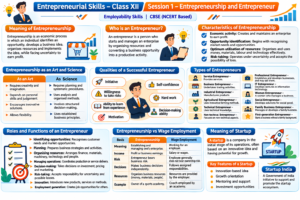
1.1 Meaning of Entrepreneurship
The word entrepreneur is derived from the French word entreprendre, meaning to undertake.
Entrepreneurship is an economic process in which an individual identifies an opportunity, develops a business idea, organises resources and implements the idea while facing uncertainty to earn profit.
Entrepreneurship involves creativity, innovation, planning, risk-taking and efficient resource utilisation.
1.2 Who is an Entrepreneur?
An entrepreneur is a person who starts and manages an enterprise by organising resources and converting a business opportunity into a productive activity.
An entrepreneur may be motivated by financial profit, personal achievement, innovation or social development.
Example: A sports instructor who opens a karate training academy, purchases equipment, hires coaches and manages admissions is an entrepreneur.
1.3 Characteristics of Entrepreneurship
According to the NCERT textbook, entrepreneurship has four major characteristics.
1. Economic activity: Entrepreneurship involves creating, developing and maintaining an enterprise that aims to earn profit.
2. Opportunity identification: It begins with recognising market needs and identifying opportunities to provide products or services.
3. Optimum utilisation of resources: Entrepreneurs organise and use available money, materials, labour and technology effectively.
4. Risk-taking: Entrepreneurs operate under uncertainty and accept the possibility of financial loss or business failure.
1.4 Entrepreneurship as an Art and Science
Entrepreneurship is considered both an art and a science.
| Entrepreneurship as an Art | Entrepreneurship as a Science |
|---|---|
| Requires creativity and imagination | Requires planning and systematic procedures |
| Depends on personal skills and judgement | Uses analysis and organised methods |
| Encourages innovative solutions | Involves structured decision-making |
| Allows flexibility | Uses established business principles |
Entrepreneurship combines creative thinking with systematic planning to develop and manage successful enterprises.
1.5 Qualities of a Successful Entrepreneur
The textbook identifies seven important qualities.
1. Initiative: An entrepreneur takes action to identify and use opportunities before they disappear.
2. Willingness to take risks: An entrepreneur accepts uncertainty and takes calculated business risks.
3. Ability to learn from experience: Entrepreneurs analyse mistakes and use lessons from previous experiences to improve their decisions.
4. Motivation: Motivation encourages entrepreneurs to remain committed to their objectives and complete difficult tasks.
5. Self-confidence: Confidence helps entrepreneurs make decisions, face challenges and inspire others.
6. Hard work: Entrepreneurs must continuously work to solve problems, satisfy customers and achieve business goals.
7. Decision-making ability: Entrepreneurs need to make suitable and timely decisions to avoid losses and take advantage of opportunities.
1.6 Types of Entrepreneurs
The NCERT textbook describes the following types of entrepreneurs.
| Type | Meaning |
|---|---|
| Service Entrepreneur | Provides services to customers |
| Business Entrepreneur | Undertakes trading and business activities |
| Industrial Entrepreneur | Manufactures products to meet customer needs |
| Agricultural Entrepreneur | Uses innovative agricultural methods |
| Technical Entrepreneur | Uses technical knowledge to develop products or processes |
| Non-technical Entrepreneur | Focuses on non-technical aspects of products and services |
| Professional Entrepreneur | Establishes and develops businesses, then may sell them |
| IT Entrepreneur | Develops ventures in information technology |
| Women Entrepreneur | Woman who establishes and manages a business |
| Social Entrepreneur | Develops solutions benefiting society |
| Family Business Entrepreneur | Manages or develops an inherited family business |
| First-generation Entrepreneur | Starts a business without a family entrepreneurship background |
1.7 Roles and Functions of an Entrepreneur
Entrepreneurs perform several important functions.
Identifying opportunities: They recognise customer needs and market opportunities.
Planning: They prepare business strategies and organise activities.
Organising resources: They arrange finance, raw materials, machinery, technology and employees.
Managing production and operations: They coordinate the activities required to produce goods or provide services.
Decision-making: They make decisions related to investment, pricing, marketing and business development.
Risk-taking: They accept responsibility for uncertainty and possible losses.
Innovation: They introduce new products, services, processes or business methods.
Employment generation: They create opportunities for other people to work and earn income.
1.8 Entrepreneurship and Wage Employment
| Basis | Entrepreneurship | Wage Employment |
|---|---|---|
| Meaning | Establishing and managing one’s enterprise | Working for an employer |
| Income | Profit or business earnings | Salary or wages |
| Risk | Business owner bears business risk | Employee generally does not bear ownership risk |
| Decisions | Entrepreneur makes business decisions | Employee follows organisational responsibilities |
| Resources | Entrepreneur organises business resources | Employer generally provides workplace resources |
| Example | Owner of a sports academy | Coach employed by an academy |
1.9 Meaning of Startup
A startup is a company in the initial stage of its operations.
The NCERT textbook explains that startups often begin with innovative ideas, may use technology-based solutions and seek investment to support business growth.
Important characteristics include innovation, growth orientation, mentoring and investment support.
Startup India is a Government of India initiative intended to support the startup ecosystem.
Complete Syllabus Physical Activity Trainer(Click Here)
Communication Skill Notes(Click Here)