
Table of Contents
Entrepreneurial skills class 12 notes pdf
Session 2 – Barriers to Entrepreneurship
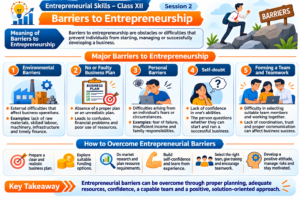
2.1 Meaning of Barriers to Entrepreneurship
Barriers to entrepreneurship are obstacles or difficulties that prevent individuals from starting, managing or successfully developing a business.
Starting an enterprise involves risks and uncertainties. Entrepreneurs may face financial problems, lack of resources, insufficient knowledge, personal fears or difficulties in building a suitable team.
2.2 Types of Barriers to Entrepreneurship
1. Environmental Barriers
Environmental barriers are external difficulties that affect business operations.
Examples include:
Lack of adequate raw materials and resources.
Non-availability of skilled labour.
Lack of machinery and infrastructure.
Unavailability of financial resources at the required time.
These barriers can be reduced through market research, proper planning, surveys and guidance from experienced mentors.
2. No or Faulty Business Plan
A business plan explains how an enterprise will achieve its objectives.
Without proper planning, entrepreneurs may face confusion, financial problems and difficulty organising activities.
A suitable business plan helps define business goals, identify resources, assign responsibilities and monitor progress.
3. Personal Barriers
Personal barriers are difficulties arising from an individual’s fears, circumstances or limitations.
Entrepreneurs may worry about business failure, insufficient income, customer acceptance and family responsibilities.
4. Self-doubt
Self-doubt occurs when individuals lack confidence in their abilities and question whether they can succeed.
Entrepreneurs can overcome self-doubt by setting clear goals, working consistently, seeking encouragement and learning from experience.
5. Forming a Team and Teamwork
Building an effective team can be challenging.
Entrepreneurs must select suitable workers, provide training and encourage cooperation among employees.
2.3 How to Overcome Entrepreneurial Barriers
| Barrier | Possible Solution |
|---|---|
| Financial difficulties | Explore suitable funding opportunities and manage money carefully |
| Lack of resources | Research suppliers and plan resource requirements |
| Poor business planning | Prepare a clear and realistic business plan |
| Self-doubt | Build confidence and work towards defined goals |
| Fear of failure | Learn from mistakes and seek guidance |
| Team-building difficulties | Recruit suitable workers and encourage teamwork |
Session 3 – Entrepreneurial Attitudes
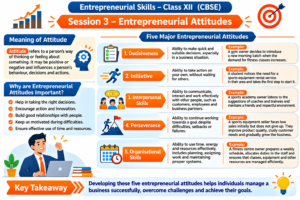
3.1 Meaning of Attitude
Attitude refers to a person’s way of thinking or feeling about something.
An attitude may be positive or negative and influences an individual’s behaviour, decisions and actions.
Entrepreneurs need positive attitudes because they frequently face uncertainty, difficulties and changing business conditions.
3.2 Important Entrepreneurial Attitudes
The NCERT textbook identifies five major entrepreneurial attitudes.
| Attitude | Meaning |
|---|---|
| Decisiveness | Ability to make quick and suitable decisions |
| Initiative | Ability to take action before others |
| Interpersonal Skills | Ability to interact and work effectively with others |
| Perseverance | Ability to continue working despite difficulties |
| Organisational Skills | Ability to use time, energy and resources effectively |
3.3 Decisiveness
Decisiveness is the ability to make timely and suitable decisions.
An entrepreneur must evaluate available opportunities and select appropriate actions without unnecessary delay.
Example: A fitness centre owner notices increasing demand for morning yoga classes and decides to introduce a new morning batch.
3.4 Initiative
Initiative refers to the ability to take charge and act in a situation before others.
Entrepreneurs with initiative do not wait for someone else to solve problems or identify opportunities.
They recognise situations in which action is possible, believe in their ability and take the necessary steps.
3.5 Interpersonal Skills
Interpersonal skills are the abilities required to communicate, interact and work effectively with other people.
These skills help entrepreneurs build relationships with customers, employees, suppliers and business partners.
Important interpersonal skills include active listening, positive body language, respectful communication and constructive feedback.
3.6 Perseverance
Perseverance is the ability to continue working towards a goal even when difficulties arise.
Entrepreneurs develop perseverance by not giving up, working hard and learning from failures.
Example: A sports equipment seller experiences low sales but improves product quality, studies customer needs and continues working towards business growth.
3.7 Organisational Skills
Organisational skills refer to the ability to use time, energy and resources efficiently to achieve objectives.
These skills include planning activities, setting priorities, assigning responsibilities and maintaining quality standards.