
Table of Contents
Notes Entrepreneurial skills class 12
Session 4 – Entrepreneurial Competencies
4.1 Meaning of Entrepreneurial Competencies
Competency refers to the ability to perform a task effectively.
Entrepreneurial competencies are the knowledge, abilities and behaviours that enable entrepreneurs to manage their businesses successfully.
The textbook explains competencies through five entrepreneurial attitudes: decisiveness, initiative, interpersonal skills, perseverance and organisational skills.
4.2 Competencies Related to Decisiveness
Decisiveness can be developed through four important activities.
1. Knowing Yourself: Understand personal interests, strengths, abilities and the problems you want to solve.
2. Identifying Opportunities: Recognise customer needs and discover suitable business opportunities.
3. Analysing Opportunities: Study market demand, customer opinions, competition and possible challenges.
4. Problem-solving: Improve business ideas and develop practical solutions to identified problems.
4.3 Competencies Related to Initiative
Taking initiative involves three important steps:
Realise that you can take action in a particular situation.
Believe in your ability to perform the required action.
Take action to achieve the desired result.
Initiative helps entrepreneurs convert ideas into business activities.
4.4 Competencies Related to Interpersonal Skills
Listening: Listening carefully helps entrepreneurs understand customers and employees and build trust.
Positive Body Language: Appropriate gestures, facial expressions and posture encourage effective communication.
Positive Attitude: Optimism helps entrepreneurs approach challenges constructively and give or receive feedback.
Stress Management: Entrepreneurs must manage pressure to maintain their health and workplace relationships.
The textbook suggests physical exercise, walking in nature, deep breathing, meditation and yoga as stress-management methods.
4.5 Competencies Related to Perseverance
Perseverance can be developed through:
Not giving up during difficult situations.
Working hard to achieve business goals.
Analysing failures and learning from mistakes.
The textbook explains that entrepreneurs should treat unsuccessful experiences as opportunities for improvement.
4.6 Competencies Related to Organisational Skills
1. Time Management
Time management means planning and controlling the time spent on different activities.
Effective time management includes preparing schedules, setting deadlines, delegating responsibilities and completing important tasks first.
2. Goal Setting
A goal is an aim or desired result that an individual wants to achieve.
Goals provide direction and encourage entrepreneurs to work harder and more efficiently.
3. Efficiency
Efficiency refers to completing tasks successfully without unnecessarily wasting time, money, effort or materials.
Entrepreneurs can improve efficiency by dividing responsibilities among team members and using available resources carefully.
4. Managing Quality
Quality management means establishing and maintaining suitable standards for products or services.
Maintaining quality is important for customer satisfaction and the long-term success of an enterprise.
Quick Revision – Entrepreneurial Skills Class XII
| Important Term | Meaning |
|---|---|
| Entrepreneur | Person who starts and manages an enterprise |
| Entrepreneurship | Process of identifying and developing business opportunities |
| Initiative | Taking action without waiting for others |
| Risk | Possibility of an undesirable outcome |
| Startup | Company in its initial stage of operations |
| Business Plan | Plan describing business objectives and activities |
| Self-doubt | Lack of confidence in personal abilities |
| Decisiveness | Ability to make timely decisions |
| Interpersonal Skills | Ability to work and communicate with others |
| Perseverance | Continuing efforts despite difficulties |
| Competency | Ability to perform a task effectively |
| Time Management | Effective planning and utilisation of time |
| Efficiency | Achieving results without unnecessary waste |
| Quality Management | Maintaining suitable standards of products or services |
Important Questions and Answers
Q1. Define entrepreneurship.
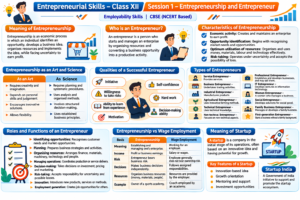
Answer: Entrepreneurship is an economic process in which an individual identifies business opportunities, develops ideas, organises resources and establishes an enterprise while accepting uncertainty to earn profit.
Q2. Who is an entrepreneur?
Answer: An entrepreneur is a person who starts and manages an enterprise by organising resources, taking risks and converting opportunities into productive business activities.
Q3. Mention four characteristics of entrepreneurship.
Answer: Entrepreneurship is an economic activity, begins with identifying opportunities, involves optimum utilisation of resources and requires risk-taking.
Q4. Why is entrepreneurship considered both an art and a science?
Answer: Entrepreneurship is an art because it requires creativity, imagination and personal judgement. It is a science because it also involves systematic planning, procedures and analysis.
Q5. Write any five qualities of a successful entrepreneur.
Answer: Initiative, willingness to take risks, motivation, self-confidence and decision-making ability are five important qualities of a successful entrepreneur.
Q6. What are the major barriers to entrepreneurship?
Answer: Major barriers include environmental difficulties, lack of a suitable business plan, personal barriers, self-doubt and problems in forming an effective team.
Q7. What is decisiveness?
Answer: Decisiveness is the ability to make timely and suitable decisions. It helps entrepreneurs recognise opportunities, solve problems and respond to changing business conditions.
Q8. Define initiative.
Answer: Initiative is the ability to take charge and act in a situation before others. It helps entrepreneurs convert business ideas into practical actions.
Q9. What are interpersonal skills?
Answer: Interpersonal skills are the abilities required to communicate and work effectively with others. They include listening, positive body language, constructive feedback and respectful interaction.
Q10. What is perseverance?
Answer: Perseverance is the ability to continue working towards a goal despite difficulties. It involves hard work, determination and learning from failures.
Q11. Explain the importance of organisational skills.
Answer: Organisational skills help entrepreneurs manage time, energy and resources effectively. They support planning, goal setting, efficiency, delegation and quality management.
Q12. What is entrepreneurial competency?
Answer: Entrepreneurial competency refers to the knowledge, abilities and behaviours required to perform entrepreneurial activities effectively and manage a business successfully.
Q13. Explain the four competencies related to decisiveness.
Answer: The four competencies are knowing yourself, identifying opportunities, analysing opportunities and problem-solving. Together, they help entrepreneurs make informed business decisions.
Q14. How can entrepreneurs improve time management?
Answer: Entrepreneurs can improve time management by preparing schedules, setting goals and deadlines, delegating responsibilities and completing high-priority tasks first.
Q15. Why is quality management important for entrepreneurs?
Answer: Quality management helps maintain suitable product and service standards. It supports customer satisfaction, builds trust and contributes to business success.
Practical Activities
Activity 1 – Entrepreneur Interview: Interview a local entrepreneur and ask about their business idea, major challenges, risks and methods of overcoming difficulties.
Activity 2 – Identify Business Opportunities: Form groups and identify problems faced by people in your community. Develop business ideas that could solve these problems.
Activity 3 – Entrepreneurial Attitudes: Select a successful entrepreneur and identify examples of decisiveness, initiative, interpersonal skills, perseverance and organisational skills.
Activity 4 – Business Planning: Prepare a simple plan for a small enterprise, such as a fitness centre, yoga studio or sports coaching academy. Include the target customers, required resources, estimated expenses and business goals.
Conclusion
Entrepreneurial Skills help individuals identify opportunities, develop business ideas, organise resources and establish successful enterprises.
The four sessions in this chapter explain the meaning and characteristics of entrepreneurship, common barriers faced by entrepreneurs, positive entrepreneurial attitudes and essential entrepreneurial competencies.
Developing qualities such as initiative, confidence, perseverance, decision-making, time management and problem-solving can help students become effective entrepreneurs.
Source: NCERT Employability Skills – Class XII, Unit 4: Entrepreneurship Skills, textbook.
Complete Syllabus of Physical Activity Trainer(Click Here)
Other parts of Employability Skills: