
Table of Contents
self management skills question and answers
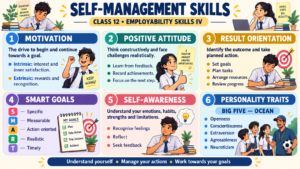
Lets start with self management skills question and answers
Self Management Skills Class 12 Questions and Answers
Physical Activity Trainer | Employability Skills IV
1. What is self-management?
Answer: Self-management is the ability to regulate our thoughts, emotions and behaviour in different situations while working towards personal and academic goals. It involves self-motivation, discipline, responsibility and awareness of our strengths and limitations.
2. Why are self-management skills important for a Physical Activity Trainer?
Answer: Self-management skills help a Physical Activity Trainer to:
- Prepare and conduct sessions punctually.
- Organise equipment and activities.
- Remain calm during challenging situations.
- Respond constructively to feedback.
- Set goals and review participants’ progress.
- Maintain respectful relationships with participants and colleagues.
3. What are the three main areas of self-management covered in this unit?
Answer: The three main areas are:
- Motivation and positive attitude: Developing the willingness to act and think constructively.
- Result orientation: Identifying goals and taking planned steps to achieve them.
- Self-awareness: Understanding our emotions, habits, personality and behaviour.
4. What is motivation?
Answer: Motivation is the drive that encourages a person to begin an activity, make an effort and continue towards a goal.
Example: A trainee practises exercise demonstrations regularly because she wants to become a capable Physical Activity Trainer.
5. What are motives? Differentiate between needs and desires.
Answer: Motives are the reasons behind our actions. They may arise from needs or desires.
| Basis | Needs | Desires |
|---|---|---|
| Meaning | Important requirements for living and functioning | Things a person wants to obtain or achieve |
| Examples | Food, rest, safety and belonging | A medal, recognition or a particular job |
| Influence | Encourage action to meet essential requirements | Encourage action towards preferred outcomes |
6. Differentiate between intrinsic and extrinsic motivation.
Answer:
| Intrinsic motivation | Extrinsic motivation |
|---|---|
| Comes from personal interest or inner satisfaction | Comes from outside rewards, recognition or consequences |
| The activity itself feels rewarding | An external outcome encourages participation |
| Example: Practising because you enjoy improving a skill | Example: Practising to receive a certificate |
Both types can influence the same person at the same time.
7. Explain five ways to develop self-motivation.
Answer:
- Identify your motives: Understand why the goal matters to you.
- Choose inspiring sources: Read useful books, follow suitable role models or participate in encouraging activities.
- Think expansively: Explore possibilities and remain willing to learn.
- Focus on the present: Complete useful actions instead of repeatedly worrying about past mistakes.
- Dream big and take small steps: Connect a meaningful ambition with manageable daily tasks.
8. How can a Physical Activity Trainer motivate themselves after an unsuccessful session?
Answer: The trainer should identify what went wrong, seek specific feedback and select an improvement to practise. They can review earlier achievements, prepare clearer instructions and set a manageable target for the next session.
For example, if participants misunderstood a drill, the trainer can simplify the explanation and practise the demonstration beforehand.
9. What is a positive attitude?
Answer: A positive attitude is a constructive way of thinking that recognises difficulties while looking for useful responses. It involves hope, willingness to learn and confidence that suitable effort can improve performance.
Example: After making an error, a trainee says, “I will identify the mistake and practise the correct technique.”
10. How can students make positive thinking a habit?
Answer: Students can:
- Maintain an accomplishment sheet.
- Focus on actions they can take in the present.
- Replace discouraging thoughts with realistic, constructive statements.
- Seek support from trusted friends, family members or teachers.
- Learn from feedback and mistakes.
- Maintain healthy routines and enjoyable activities.
11. What is an accomplishment sheet? How is it useful?
Answer: An accomplishment sheet is a record of completed tasks, improvements and achievements, including small successes.
It helps students recognise progress, remember their strengths and remain motivated during discouraging situations.
Example: A trainee records that they arrived punctually, demonstrated a drill clearly and successfully organised equipment.
12. What is result orientation?
Answer: Result orientation is the ability to identify an important outcome and take the necessary steps to achieve it. It includes setting clear goals, preparing an action plan, arranging resources and monitoring progress.
Example: A trainer checks whether participants can perform a skill correctly, rather than only recording that the session was completed.
13. Explain the steps to become result-oriented.
Answer:
- Set clear goals: Identify the outcome you want.
- Prepare an action plan: Divide the goal into practical steps.
- Arrange resources: Check the availability of equipment, materials and facilities.
- Consult mentors and peers: Seek guidance about realistic targets and suitable methods.
- Make a calendar: Schedule work and progress reviews.
- Work consistently: Complete the actions and adjust ineffective methods.
14. What is goal setting? Why is it important?
Answer: Goal setting is deciding what we want to achieve and identifying how to work towards it.
It is important because it:
- Gives direction to our efforts.
- Helps us choose priorities.
- Supports planning and motivation.
- Provides a basis for measuring progress.
- Connects daily actions with long-term ambitions.
15. Explain SMART goals.
Answer: In the Class XII Employability Skills textbook used for these notes, SMART stands for:
| Letter | Meaning | Explanation |
|---|---|---|
| S | Specific | State exactly what you want to achieve. |
| M | Measurable | Decide how progress or achievement will be checked. |
| A | Action-oriented | Identify the actions you will take. |
| R | Realistic | Match the goal to available time, ability and resources. |
| T | Timely | Set a deadline for completion. |
16. Give an example of a SMART goal for a Physical Activity Trainer student.
Answer: “Within two weeks, I will independently demonstrate five warm-up exercises in the correct sequence, practise for 20 minutes on five days each week and use my teacher’s checklist to assess performance.”
This goal identifies a specific skill, measurable performance, practical actions and a deadline. Its realism depends on the student’s starting ability and available resources.
17. What is an action plan? What information should it contain?
Answer: An action plan is a written outline of the steps required to achieve a goal. It should include:
- What needs to be done.
- Who will complete each task.
- When the tasks will be completed.
- Which resources are required.
- What changes or results are expected.
- Who needs information about the plan.
- How progress will be reviewed.
18. Differentiate between an activity and a result.
Answer:
| Activity | Result |
|---|---|
| An action performed while working towards a goal | The outcome achieved through the action |
| Example: Reading a chapter for one hour | Example: Explaining its main concepts accurately |
| Example: Conducting a practice session | Example: Participants demonstrating the intended skill safely |
Activities contribute to results, but completing an activity does not automatically establish that the goal has been achieved.
19. What is self-awareness?
Answer: Self-awareness is understanding our own needs, desires, emotions, habits, strengths, limitations and behaviour. It helps us recognise why we react in particular ways and how our actions affect others.
Example: A trainer recognises that they become impatient when instructions must be repeated and decides to practise responding calmly.
20. Explain the steps towards self-awareness.
Answer: The main steps are:
- Recognise emotions: Identify what you are feeling.
- Track feelings: Notice and record situations, emotions and responses.
- Extend reflection: Examine habits, decisions, relationships and other areas of life.
Specific feedback from trusted people can support this process.
21. How can self-awareness improve a trainer’s performance?
Answer: Self-awareness helps a trainer identify strengths, recognise emotional reactions and understand areas needing improvement. It supports better communication, suitable goals and more thoughtful decisions.
For example, a trainer who notices that they speak too quickly can slow down, demonstrate each step and check participants’ understanding.
22. What is personality? What are personality traits?
Answer: Personality is a person’s characteristic pattern of thoughts, feelings and behaviours.
Personality traits are relatively lasting tendencies that distinguish individuals from one another, such as curiosity, responsibility or sociability.
Personality is broader than appearance, clothing or speaking confidence.
23. Explain the Big Five personality traits with examples.
Answer:
| Trait | Meaning | Example |
|---|---|---|
| Openness | Curiosity, imagination and willingness to explore | Trying a new teaching method |
| Conscientiousness | Organisation, responsibility and self-discipline | Preparing equipment and meeting deadlines |
| Extraversion | Sociability, assertiveness and outward engagement | Comfortably interacting with a group |
| Agreeableness | Kindness, cooperation and consideration | Helping a teammate learn |
| Neuroticism | Tendency to experience worry or emotional distress | Becoming easily anxious under pressure |
These are dimensions that people show to different degrees, rather than five fixed personality types.
Terminology note: The supplied textbook edition prints “consciousness”; the standard Big Five term is “conscientiousness.”
24. How does personality influence relationships at work?
Answer: Personality influences communication, cooperation, emotional responses and work habits. Responsible behaviour can build trust, while consideration can support teamwork.
For example, a trainer who prepares carefully, listens respectfully and responds calmly is more likely to maintain productive relationships. No single personality trait guarantees professional success.
25. What are personality disorders? Name their three clusters.
Answer: Personality disorders involve enduring patterns of thinking, feeling and behaviour that cause significant distress or difficulties in functioning.
The textbook groups them into:
| Cluster | Textbook grouping | Examples |
|---|---|---|
| A | Suspicious | Paranoid, schizoid and schizotypal |
| B | Emotional and impulsive | Antisocial, borderline, histrionic and narcissistic |
| C | Anxious | Avoidant, dependent and obsessive-compulsive personality disorder |
These are educational summaries. A brief behaviour or classroom example is insufficient to diagnose a person.
26. Differentiate between personality traits and personality disorders.
Answer:
| Personality traits | Personality disorders |
|---|---|
| Describe usual tendencies in thinking, feeling and behaviour | Involve enduring patterns associated with significant distress or difficulties |
| Vary across individuals | Require professional assessment |
| Examples include openness and agreeableness | Examples include avoidant and dependent personality disorders |
A strong trait, ordinary shyness or occasional worry does not by itself indicate a disorder.
27. How can we support someone experiencing persistent personality-related difficulties?
Answer: We can listen respectfully, avoid judgement and encourage appropriate professional support. Supportive relationships, enjoyable hobbies and healthy routines may help wellbeing.
We should avoid diagnosing or labelling the person. Such activities support wellbeing but do not replace professional assessment or treatment.
28. A trainer has prepared a session but discovers that the required equipment is unavailable. Which self-management skills should they apply?
Answer: The trainer should remain calm, assess available resources and choose a suitable, safe alternative activity. They should communicate the change clearly and review how to prevent the problem in future.
This situation requires emotional regulation, problem-solving, result orientation and responsible planning.
29. A trainee practises regularly but shows little improvement. What should they do?
Answer: The trainee should compare their performance with the intended outcome, identify recurring errors and seek specific feedback. They should adjust the practice method and review progress after trying the change.
This demonstrates result orientation because the focus is on improving outcomes, not simply increasing practice time.
30. How are motivation, result orientation and self-awareness connected?
Answer: Motivation gives a person a reason to act. Result orientation helps them plan actions towards a clear outcome. Self-awareness helps them understand their abilities, emotions and behaviour.
For example, a trainee wants to become a capable instructor, prepares a practice plan and uses reflection and feedback to improve their teaching.