
Table of Contents
Self Management Skills Class 12 Notes
Self Management Skills Class 12 Notes – Lets start
Unit 2 | Employability Skills IV | Illustrated chapter notes
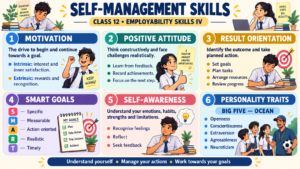
Self-management helps students control their thoughts, emotions and behaviour while working towards meaningful goals. These notes explain the three sessions in the Class XII Employability Skills textbook: Motivation and Positive Attitude, Result Orientation, and Self-Awareness. Definitions, comparison tables, practical examples and exam tips make the chapter easier to understand and revise. Examples also connect the concepts with the work of a Physical Activity Trainer.
Introduction to Self Management
Self-management is the ability to regulate one’s thoughts, feelings and actions effectively in different situations. It includes motivating oneself, accepting responsibility and working towards personal, academic and professional goals. A person who manages themselves well prepares for tasks, controls impulsive reactions and adjusts their approach after receiving feedback.
For example, a student who arrives on time, completes assignments, listens carefully and practises regularly is showing self-management. A Physical Activity Trainer demonstrates it by checking equipment before a session, explaining instructions calmly and reviewing the session afterwards. Asking for help when needed is also a responsible part of managing yourself.
Why Self Management Is Important
- It supports regular study and helps students use their time purposefully.
- It encourages discipline, punctuality and responsibility.
- It helps people respond constructively to setbacks and criticism.
- It improves cooperation because dependable behaviour builds trust.
- It makes goals clearer and connects everyday effort with long-term ambitions.
Session 1 Motivation and Positive Attitude
1.1 Meaning of Motivation
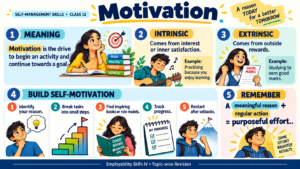
Motivation is the drive that encourages a person to begin an activity, make an effort and continue working towards a goal. It answers the question, “Why do I want to do this?” A clear personal reason can help someone continue even when the task becomes difficult or progress feels slow.
A student may study because they enjoy learning, want good marks or hope to enter a particular profession. An athlete may practise to improve technique, represent the school or experience the satisfaction of progress. Motivation becomes useful when the reason leads to regular action rather than remaining only a wish.
1.2 Motives Needs and Desires
A motive is a reason behind an action. Motives may arise from needs or desires. Needs involve important requirements such as rest, safety, belonging and learning. Desires involve things a person wants, such as recognition, a medal or a particular career. Both can influence behaviour, but people may respond differently to the same situation.
| Basis | Need | Desire |
|---|---|---|
| Meaning | An important requirement | Something a person wants |
| Example | Rest after demanding activity | Winning a tournament trophy |
| Effect on behaviour | Encourages action to meet a requirement | Encourages action towards a preferred outcome |
Listing personal motives helps students choose goals that matter to them. For example, “I want to become a reliable trainer because I enjoy helping children participate” gives a clearer direction than simply copying a friend’s career choice.
1.3 Types of Motivation
| Type | Meaning | Example |
|---|---|---|
| Intrinsic motivation | Comes from enjoyment, interest or inner satisfaction | Practising a skill because learning it feels rewarding |
| Extrinsic motivation | Comes from an outside reward, recognition or consequence | Completing work to earn marks or receive a certificate |
Intrinsic and extrinsic motivation can work together. A learner may enjoy sports science and also want a high examination score. External rewards can encourage effort, while personal interest gives the task meaning. The aim is to build dependable habits so that work does not stop whenever praise or prizes are absent.
1.4 Factors and Sources of Self Motivation
- Clear motives: Identify your needs, interests and reasons for taking up the task.
- Inspiring sources: Use suitable books, music, biographies, activities or role models to renew enthusiasm.
- Expansive thinking: Consider possibilities, welcome learning and avoid assuming that present difficulties define your future.
- Living in the present: Focus on the step you can complete now instead of repeatedly worrying about yesterday or tomorrow.
- Dreaming big: Choose a meaningful ambition, then divide it into practical smaller goals.
- Visible progress: Record completed tasks and improvements so that effort becomes easier to recognise.
1.5 Ways to Develop Self Motivation
Begin with a task small enough to start immediately. Replace “I must finish the entire chapter” with “I will understand the first topic and write five key points.” Prepare the required materials, reduce distractions and decide when to begin. After completing the task, check what you learned and choose the next step.
Useful feedback also supports motivation. If a presentation does not go well, ask which part needs improvement. Practise that part and try again. Comparing present performance with your own earlier performance often gives more useful information than constantly comparing yourself with others.
1.6 Meaning of Positive Attitude
A positive attitude is a constructive way of thinking that recognises difficulties while looking for useful responses. It involves hope, willingness to learn and confidence that effort can improve a situation. Positive thinking does not require pretending that every situation is easy or that success is guaranteed.
For example, after a disappointing test result, a constructive response is: “My preparation was incomplete. I will identify weak topics and change my revision plan.” This response accepts the result and creates a next step. Saying “I can never improve” discourages effort and gives no direction.
1.7 Benefits of Positive Thinking
- Encourages a person to attempt unfamiliar tasks.
- Supports persistence when improvement takes time.
- Helps people receive feedback with less defensiveness.
- Promotes cooperative behaviour and more constructive conversations.
- Helps people focus attention on actions within their control.
1.8 Making Positive Thinking a Habit
Keep an accomplishment sheet containing small achievements, such as completing revision, arriving punctually or improving a demonstration. Read it when discouraging thoughts appear. Spend time with supportive people and speak to friends, family members or teachers when difficulties feel overwhelming. Helpful routines include suitable physical activity, adequate rest, enjoyable hobbies and quiet reflection.
| Unhelpful thought | Constructive response |
|---|---|
| I always fail | This attempt did not work; I can review the reason |
| Everyone is better than me | I can measure my progress and identify my next step |
| This task is impossible | I can divide it into smaller parts and ask for guidance |
| One mistake has ruined everything | I can correct what is possible and learn from the mistake |
Session 2 Result Orientation
2.1 Meaning of Result Orientation
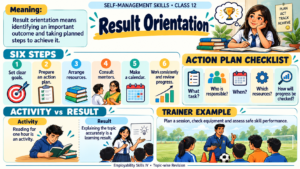
Result orientation is the ability to recognise the outcome that matters and take the steps needed to achieve it. It involves clear targets, purposeful effort and regular checks of progress. A result-oriented learner asks both “What am I trying to achieve?” and “Is my present method helping me achieve it?”
For example, reading a chapter for one hour is an activity. Being able to explain its main concepts without looking at the book is a learning result. Time spent matters, but checking understanding tells the learner whether the method is effective. In physical activity training, completing a session should be accompanied by checking whether participants understood and performed the intended skills safely.
2.2 How to Become Result Oriented
- Set clear goals: State the outcome you want to achieve.
- Prepare an action plan: Break the goal into steps and assign time to them.
- Use suitable resources: Arrange books, equipment, practice space and other materials.
- Consult mentors and peers: Seek advice about realistic targets and effective methods.
- Make a calendar: Schedule work and review progress at regular intervals.
- Work consistently: Complete planned actions and improve the approach when necessary.
For Complete Syllabus of Physical Activity Trainer(CLICK HERE)