
Table of Contents
Self management skills class 12 notes pdf

Self management skills class 12 notes pdf – lets Start
2.3 Meaning of Goal Setting
Goal setting is deciding what you want to achieve and identifying how you will work towards it. A useful goal has a purpose, an expected outcome and a way to check progress. “I want to do better” expresses an intention, but it does not explain what improvement means or when it should happen.
Goals can cover different time periods. Finishing a topic this evening is a short-term goal. Completing a training qualification is a longer-term goal. Smaller goals should support the larger aim so that everyday work has a clear direction.
2.4 SMART Goals
| Letter | Meaning | Explanation |
|---|---|---|
| S | Specific | State exactly what you want to achieve |
| M | Measurable | Choose evidence that shows progress or completion |
| A | Action-oriented | Identify actions you will take |
| R | Realistic | Match the target to available time, ability and resources |
| T | Timely | Set a deadline or time limit |
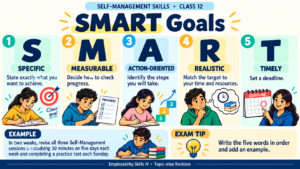
Example: “During the next two weeks, I will revise all three sessions of Self-Management Skills, study for 30 minutes on five days each week and answer a practice set every Sunday, aiming for at least 80% correct answers.” The target describes the subject, measure, actions and deadline. Its realism depends on the learner’s starting point and available time.
2.5 Preparing an Action Plan
An action plan records the steps needed to achieve a target. It should show what will be done, who will do it, when it will happen and which resources are required. It should also identify who needs to receive updates. A written plan makes missed steps and resource gaps easier to notice.
| Action | Resources | Time | Evidence of completion |
|---|---|---|---|
| Read Session 1 and make summary notes | Textbook and notebook | Monday | One-page summary |
| Learn SMART and prepare a personal goal | Notes and timetable | Tuesday | Completed goal statement |
| Revise personality traits | Revision table | Wednesday | Explain five traits with examples |
| Review learning through practice | Questions and answer notes | Friday | Errors identified and corrected |
2.6 Monitoring and Improving Progress
Review progress at fixed intervals. Compare the expected result with the actual result and identify the reason for any gap. If you cannot recall definitions after repeatedly reading them, try answering questions from memory and then checking your answers. If equipment is unavailable, arrange an alternative before the scheduled session.
Changing an ineffective method is part of result orientation. It is also important to follow fair procedures and safety requirements. A trainer should never pursue a performance target by ignoring participant wellbeing. Useful outcomes include understanding, appropriate participation and safe skill development.
Sources and Study Note
These original explanatory notes are based primarily on Unit 2 of the supplied Employability Skills – Class XII textbook. The session headings and SMART terminology follow that edition. The linked Communication Skills article is used as a reference for presentation structure. Examples, tables and revision questions here are newly written; consult your school’s prescribed edition and current syllabus for assessed scope.
CBSE Employability Skills Class XII textbook · Reference format