
Table of Contents
Self-management Skills Notes
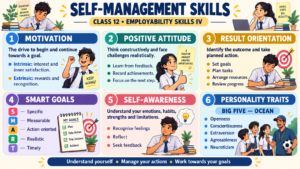
Self-management Skills Notes- Lets start
Session 3 Self Awareness
3.1 Meaning of Self Awareness
Self-awareness is understanding your own needs, desires, habits, emotions, strengths, limitations and behaviour. It helps you recognise why you react in a particular way and how your actions affect other people. This understanding makes it easier to choose suitable goals and respond thoughtfully.
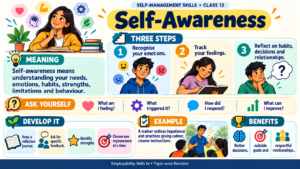
For example, a student notices that they interrupt others when excited. Recognising the pattern allows them to practise pausing and listening. A trainer who knows they become impatient when instructions must be repeated can prepare simpler explanations and check understanding more calmly.
3.2 Steps towards Self Awareness
- Recognise emotions: Notice whether you feel excited, disappointed, nervous, frustrated or calm.
- Track feelings: Record the situation, your reaction and its effect in a short journal.
- Extend reflection: Examine your habits, decisions, relationships, strengths and areas needing improvement.
Feedback from trusted people can reveal patterns that you have missed. Ask for a specific observation rather than a general judgement. “Were my instructions clear?” is more useful than “Am I good?” Combine feedback with your own reflection and choose one practical improvement at a time.
3.3 Meaning of Personality
Personality is a person’s characteristic pattern of thoughts, feelings and behaviours. It helps explain why individuals respond differently to similar situations. Personality develops through the interaction of temperament, experience, environment and culture. It is broader than appearance, clothing or the ability to speak confidently.
Personality influences cooperation, relationships and work habits. A dependable person is more likely to complete an agreed task, while a considerate person may notice when a teammate needs support. People can develop helpful habits without needing to become identical to someone else.
3.4 Personality Traits and the Big Five
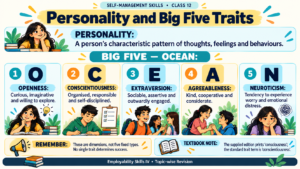
Personality traits are relatively lasting tendencies in how people think, feel and behave. The Five Factor Model describes five broad dimensions. A person can show different levels of each trait; these are not five fixed categories into which everyone must fit.
| Trait | Main idea | Everyday example |
|---|---|---|
| Openness | Curiosity, imagination and willingness to explore | Trying a new teaching activity |
| Conscientiousness | Organisation, responsibility and self-discipline | Preparing equipment and meeting deadlines |
| Extraversion | Sociability, assertiveness and outward engagement | Comfortably addressing a group |
| Agreeableness | Kindness, cooperation and consideration | Helping a teammate learn a skill |
| Neuroticism | Tendency to experience distress or emotional instability | Becoming worried easily under pressure |
Introversion and extraversion describe tendencies rather than ability or worth. A quieter person may be an effective trainer through careful preparation and attentive listening. A sociable person may be comfortable leading groups but still needs planning and sound judgement. No single trait guarantees success.
3.5 Common Personality Disorders
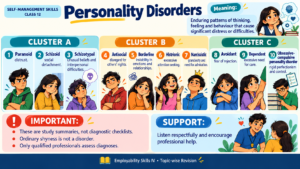
The textbook also introduces personality disorders. These involve enduring patterns of thinking, feeling and behaviour that create significant difficulties or distress. The descriptions below are brief educational summaries. An occasional behaviour, ordinary shyness or a difficult day does not establish a disorder; assessment requires a qualified mental health professional.
| Cluster | Disorder | Brief description |
|---|---|---|
| A | Paranoid | Persistent distrust and suspicion of other people |
| A | Schizoid | Marked detachment from social relationships and limited emotional expression |
| A | Schizotypal | Unusual beliefs or perceptions together with interpersonal difficulties |
| B | Antisocial | Persistent disregard for the rights of others |
| B | Borderline | Instability in emotions, self-image and relationships, sometimes with impulsivity |
| B | Histrionic | A persistent pattern of excessive emotional expression and attention seeking |
| B | Narcissistic | A pattern involving grandiosity, need for admiration and limited empathy |
| C | Avoidant | Avoidance linked with feelings of inadequacy and sensitivity to rejection |
| C | Dependent | An excessive need to be cared for and difficulty acting independently |
| C | Obsessive-compulsive personality disorder | A rigid preoccupation with order, perfectionism and control |
Cluster A is commonly described as odd or eccentric; Cluster B as dramatic, emotional or erratic; and Cluster C as anxious or fearful. The textbook uses shorter labels such as suspicious, emotional and impulsive, and anxious. These groupings help organise the lesson but do not describe every individual in the same way.
3.6 Support and Healthy Habits
Listen respectfully when someone shares a difficulty, avoid labels and encourage appropriate professional support. Healthy routines, enjoyable hobbies, physical activity, supportive relationships and confidence-building activities can support wellbeing. They should not be described as guaranteed cures or substitutes for professional care.
Quick Revision
| Concept | Key point |
|---|---|
| Self-management | Regulate thoughts, emotions and behaviour |
| Motivation | The drive to begin and continue action |
| Intrinsic motivation | Interest or satisfaction from the activity |
| Extrinsic motivation | Outside reward, recognition or consequence |
| Positive attitude | Constructive thinking combined with realistic action |
| Result orientation | Identify the desired outcome and work towards it |
| Action plan | Steps, timing, responsibility and resources |
| Self-awareness | Understand your feelings, habits and characteristics |
| Personality | Characteristic patterns of thoughts, feelings and behaviour |
Important Questions and Answers
Q1. What is self-management?
Answer: Self-management is the ability to regulate thoughts, emotions and behaviour in different situations while working towards goals. It includes self-motivation, responsible choices, discipline and reviewing one’s actions.
Q2. Differentiate between intrinsic and extrinsic motivation.
Answer: Intrinsic motivation comes from interest, enjoyment or personal satisfaction, such as practising because you enjoy learning. Extrinsic motivation comes from outside rewards or consequences, such as studying to obtain marks or a certificate.
Q3. How can students develop a positive attitude?
Answer: Students can record achievements, use constructive self-talk, focus on present actions, seek support and learn from feedback. A positive attitude recognises a difficulty and asks what useful action can follow.
Q4. What is result orientation?
Answer: Result orientation means identifying an important outcome and taking planned steps to achieve it. It involves setting goals, arranging resources, working consistently and monitoring progress.
Q5. Explain SMART goals.
Answer: In the supplied Class XII textbook, SMART stands for Specific, Measurable, Action-oriented, Realistic and Timely. These features make a goal clear, practical and easier to evaluate.
Q6. What information should an action plan include?
Answer: An action plan should identify the tasks, expected changes, responsible people, time limits, resources and communication required. A review date helps check whether the steps are producing the desired result.
Q7. Why is self-awareness important?
Answer: Self-awareness helps people recognise emotions, identify strengths, understand limitations and improve behaviour. It supports suitable decisions and helps people understand their effect on others.
Q8. Name the Big Five personality traits.
Answer: The five traits are openness, conscientiousness, extraversion, agreeableness and neuroticism. They describe broad dimensions of personality rather than five fixed types of people.
Q9. How can self-management help a Physical Activity Trainer?
Answer: It helps a trainer prepare sessions, arrive punctually, manage emotions, communicate respectfully and review participant learning. These habits make training more organised and dependable.
Q10. How should we respond to someone experiencing persistent personality-related difficulties?
Answer: Listen without judging, respect the person and encourage help from a qualified professional. Avoid diagnosing the person from a short description or assuming that hobbies alone will resolve the difficulty.
Practice Activities
- My motivation list: Write one learning goal, your reason for choosing it, one internal source of motivation and one external source.
- My accomplishment sheet: Record three small achievements each week and explain what helped you complete them.
- My SMART goal: Set a two-week study goal using the textbook expansion and identify how you will measure progress.
- My reflection journal: Record a challenging situation, the emotion you noticed, your response and a better response for next time.
- My trainer action plan: Plan a short activity session. List equipment, instructions, time, safety checks and the learning outcome.
Sources and Study Note
These original explanatory notes are based primarily on Unit 2 of the supplied Employability Skills – Class XII textbook, printed pages 23–38. The session headings and SMART terminology follow that edition. The linked Communication Skills article is used as a reference for presentation structure. Examples, tables and revision questions here are newly written; consult your school’s prescribed edition and current syllabus for assessed scope.
CBSE Employability Skills Class XII textbook · Reference format